Unusual Things to Do in Madrid: A Local’s Take on the Unexpected
Most people visit Madrid Spain for the big names—the Royal Palace, Plaza Mayor, or the Prado Museum—but the Spanish capital’s real charm hides in its everyday surprises. It’s a city where you can buy cookies from cloistered nuns through a hidden turntable, sip espresso in a tiled café older than your grandparents, and find an Egyptian temple glowing gold at sunset.
If you’ve already seen the classics, this guide is your key to the unusual things to do in Madrid—the tucked-away markets, underground museums, and neighborhoods full of life and color. Each stop reveals how creativity and tradition still live side by side here.
Quick highlights you’ll discover ahead:
-
Street art walks through Lavapiés and Embajadores
-
Rooftop sunset views at the Egyptian Temple of Debod
-
Underground ghost stations and vintage train platforms
-
Secret gardens, cube croissants, and centuries-old taverns
Madrid rewards the curious—ready to explore its hidden gems?

El Retiro Park & the Crystal Palace — Art, Water, and a Living Botanical Garden
In the heart of Madrid Spain, El Retiro Park is where the city catches its breath. Once a royal retreat, today it’s where locals jog, musicians play, and freelancers stretch out under trees between calls. For travelers seeking offbeat experiences in Madrid, Retiro holds more than lawns and fountains—it’s full of creative corners and quiet surprises that feel miles away from the busy downtown area. Here are some of the most interesting places around El Retiro Park that most tourists miss.
The Crystal Palace: Where Art and Light Collide
Built in 1887 for the Philippines Exhibition, the Crystal Palace (Palacio de Cristal) remains one of Madrid’s most captivating landmarks.

Why go:
-
Free rotating art installations curated by the Reina Sofía Museum.
-
Flooded with natural light—photographers love late-afternoon reflections.
-
Surrounded by a lake and marble statues tucked beneath leafy canopies.
Local tip: Visit right before sunset for the best light and smaller crowds.
Nearby stop: The Fallen Angel Statue—the only public monument to Lucifer in Europe, tucked within the same park.
Jardines de Cecilio Rodríguez: Madrid’s Peacock Garden

Step off the main paths to find the Jardines de Cecilio Rodríguez, a sequence of enclosed courtyards filled with fountains, pergolas, and elegant residents—free-roaming peacocks.
Why go:
-
A calm, classical garden designed for slow strolls and quiet observation.
-
Perfect for photography, sketching, or quiet reading sessions.
-
Often empty except for a few locals—making it one of Retiro’s hidden gems.
Coffee nearby: The Bear and the Madroño or Norah Coffee—both offer great coffee, WiFi and quaint seating.
Royal Garden Beside the Prado: A Living Museum

Next to the Prado Museum, The Royal Garden, or the Real Jardín Botánico, is a historic green space (1755) that forms a peaceful bridge between art and nature. It’s a paradise for those who love science and slow travel.
Why go:
-
Themed zones dedicated to Mediterranean, tropical, and desert flora.
-
Quiet benches ideal for reading or taking a break between museums.
-
Seasonal exhibits in the historic greenhouse (check schedules before you go).
Don’t miss: The cactus garden near the entrance—it feels like stepping from Europe straight into Mexico and also the Terraza Atenas roof top bar for a nice post stroll drink while you're still in the garden space.
Cuesta de Moyano: Madrid’s Outdoor Book Street

Just outside Retiro’s south gate, rows of green wooden stalls line Cuesta de Moyano,one of Madrid’s oldest book markets.
Why go:
-
Vintage Spanish novels, art books, and collectible editions from family-run stalls.
-
Located between El Retiro Park and the Literary Quarter (Barrio de las Letras).
-
Great for travelers who like souvenirs with soul, not price tags.
Nomad pick: Bring your laptop—there’s public WiFi nearby and plenty of shaded benches for reading or remote work.
Casita del Pescador & Retiro Lake: Everyday Rituals

When you need a change of scenery, stroll to the Casita del Pescador, a pastel-colored house floating above the lake, once used by royals for fishing.
Why go:
-
Rent a rowboat (€8–€10 for 45 minutes).
-
Listen to street musicians and watch locals sketch or dance.
-
Best spot in the park for an unhurried stroll and true Madrid calm.
Snack idea: Pick up a sandwich at La Rollerie before heading in—it’s a local favorite.
Quick Recap: Why Retiro Is More Than a Park
Size: 350 acres of gardens, lakes, and monuments.
Vibe: Equal parts royal heritage and neighborhood hangout.
Best for: Creative breaks, slow mornings, and nature-driven resets.
Why it matters:
For remote workers and long-stay visitors alike, Retiro park isn’t just a place—it’s an outdoor coworking lounge, an art walk, and a mindfulness retreat rolled into one.
Between the greenhouses, the roaming peacocks, and the shimmer of the Crystal Palace, it’s proof that slowing down in Madrid can be its own kind of adventure.

Hidden Gems Underground: Andén 0, Ghost Stations, and Time Capsules
Beneath the polished streets of Madrid Spain, a forgotten network of tunnels, platforms, and exhibits tells the story of a city that never stops reinventing itself. For travelers chasing offbeat experiences in Madrid, these subterranean spaces are part time capsule, part modern art gallery—each revealing a side of Madrid few visitors ever see.
Whether it’s exploring an abandoned metro stop, stepping into a nobleman’s preserved mansion, or tracing old train routes, this is the capital at its most surprising.
Andén 0: The City’s Ghost Station
Hidden beneath Plaza de Chamberí, Andén 0 is Madrid’s original metro line turned underground museum. Known as the “ghost station,” it’s been frozen in time since the 1960s—complete with antique tiles, flickering ads, and restored carriages.
Why go:
-
See historic trains and preserved ticket booths from 1919.
-
Stroll the original platforms on a guided tour through early commuter history.
-
Admission is free, and weekend visits often include short documentaries about Madrid’s growth.
Pair your visit with a stop at nearby Café Comercial, one of Madrid’s oldest coffee houses—great for a reflective break after emerging from below ground.
Museo Cerralbo: A Hidden Mansion in the Historic Core
If the underground isn’t your style but you still love forgotten corners, step into the Museo Cerralbo, just a short walk from Plaza de España and the iconic mid-century building at the heart of it. This 19th-century aristocrat’s home feels like a set from a period film—filled with chandeliers, armor, and grand staircases that have barely changed in 120 years.
Why go:
-
A complete, untouched residence offering insight into Madrid’s pre-war elite.
-
Rich in beautiful architecture and dramatic detail—gilded mirrors, marble statues, velvet walls.
-
Far less crowded than the Prado or other renowned galleries.
San Miguel Market is only a few metro stations away—perfect for tapas after your history fix.
Museo Sorolla: Light, Art, and Serenity

North of the city center, the Museo Sorolla blends art, architecture, and calm in one of Madrid’s most atmospheric homes. It was once the residence of painter Joaquín Sorolla, whose mastery of Mediterranean light earned him global acclaim.
Why go:
-
Over 1,200 works by Sorolla, plus his original brushes and studio setup.
-
A small courtyard garden that feels as lush as the Botanical Garden.
-
Free entry on Saturdays—ideal for digital nomads craving quiet inspiration.
Sorolla’s sunlight-filled portraits inspired painters later shown at the Reina Sofia Museum, linking this intimate space to Madrid’s broader art heritage.
Mercado de Motores: Vintage Finds in a Train Museum
At first glance, this event looks like a hip flea market—but it’s actually set inside Madrid’s Railway Museum the Museo del Ferrocarril de Madrid. Held once a month in the Delicias Station, it combines history with local creativity.
Why go:
-
Browse vintage clothes and handmade crafts between locomotives.
-
Live music and craft-beer stands add a social edge to the nostalgia.
-
Great weekend stop if you like mixing culture, design, and conversation.
Bring your camera; the contrast between rusted trains and designer stalls is striking.
Other Hidden Corners to Add to Your Map
-
Chamberí’s Ghost Station (Andén 0): time travel by metro.
-
La Tabacalera** (Lavapiés):** a former tobacco factory now alive with street art and open exhibitions.
-
Cine Doré: art-deco cinema screening classic films in original language.

-
Museo del Romanticismo: an intimate stop for fans of 19th-century interiors and poetry.
Why You’ll Love Madrid Underground
Vibe: quiet, curious, cinematic.
Best for: travelers who like peeling back layers of history instead of ticking off monuments.
Exploring below the surface shows how Madrid’s past and present coexist in a strange gnarly mix that has for centuries inspired writers and poets. These ghost stations and house-museums are living reminders that even in a modern metropolis, time leaves fascinating traces.
Lavapiés & Embajadores, Madrid Spain. Street Art, Markets, Local Flavor
If Retiro’s gardens are where Madrid breathes, Lavapiés is where it dances. South of the city center, this once-working-class barrio has become a living canvas of color and creativity. Here, Senegalese spice shops sit beside Indian curry houses, punk cafés share walls with Arabic bakeries, and murals stretch across entire buildings.
For travelers and remote workers alike, Lavapiés and Embajadores show the Spanish capital at its most expressive and communal—a neighborhood where tradition, activism, and art collide every day.
Street Art Tours — The City’s Living Gallery
Few places in Europe capture creativity in motion like Lavapiés. Its walls change constantly—one week filled with satire, the next with social protest. The neighborhood doubles as a museum you can walk through, free of entry lines.

Why go:
-
Book a guided tour with Cooltour Spain or City Secreto Madrid to uncover the meanings behind each mural.
-
Spot major works by local legends like Okuda San Miguel and Boa Mistura.
-
Visit La Tabacalera, a former tobacco factory turned self-managed art space, filled with graffiti, exhibits, and weekend concerts.
Markets With Personality: Where Food Meets Community
The market scene here is loud, friendly, and proudly local. Skip the touristy stalls near Plaza Mayor and head to the ones where chefs, neighbors, and travelers actually cross paths.
Don’t miss:
-
Mercado de San Fernando – A neighborhood icon. Spanish tapas share space with Venezuelan arepas and Ethiopian platters. Grab a glass of vermouth at La Revoltosa.
-
El Rastro – An outdoor flea market in nearby Centro offering vintage finds and handmade art every Sunday and public holiday.
-
Mercado de Antón Martín – A short walk from Atocha; sushi bars meet traditional taverns in this buzzing two-story market.
Each space doubles as a local market and social hub—perfect for anyone who travels to connect, not just to eat.
Cultural Corners: Where History and Creativity Collide
Art spills far beyond the walls here. You can spend one afternoon listening to live jazz in a converted cinema and the next joining an open-air mural workshop.
Don’t miss:
-
La Casa Encendida – A community center known for sustainability classes, indie film screenings, and rooftop concerts at sunset.
-
Matadero Madrid – Just south in Legazpi, this former slaughterhouse is now a creative hub with exhibitions, festivals, and shared studios.

-
Cine Doré – An art deco landmark showing world cinema and Spanish classics in their original languages.
As night falls, the neighborhood’s rhythm changes—guitars, laughter, and the occasional impromptu flamenco show fill its narrow streets.
Where to Eat and People Watch
After exploring murals and markets, grab a seat and let the barrio’s rhythm take over.
-
Pum Pum Café – Boho brunch spot with fast WiFi and cold brew on tap.
-
La Musa de Espronceda – Modern tapas bar reinventing traditional plates.
-
Ouh Babbo Jazz Bar – Cozy, unpretentious, and known for late-night jam sessions.
For a perfect break, settle on Plaza de Lavapiés or Plaza de Nelson Mandela to people watch. Here, you’ll see neighbors chatting, children chasing pigeons, and street musicians tuning up for the night ahead.
Why Lavapiés Belongs on Every Nomad’s Map
Lavapiés isn’t a checklist—it’s an experience that unfolds block by block. Between its vivid murals, multicultural food markets, and open-air galleries, this area shows Madrid’s creative pulse better than any museum could. It’s raw, real, and welcoming—a reminder that the most authentic discoveries rarely appear on tourist maps.
Compare Madrid’s most creative neighborhoods with others like Goya before planning your visit and see why Lavapiés remains the city’s cultural heartbeat.

Time Travel in the City: Egyptian Temple, Royal Grandeur & Hidden Gardens
In a city that constantly looks forward, Madrid still knows how to hold on to its past. Between monumental plazas and centuries-old palaces, you’ll find entire corners that feel suspended in time. This section traces a journey through some of Madrid’s most beautiful historic spaces—from a genuine Egyptian temple glowing at sunset to royal landmarks that still shape the skyline of the Spanish capital.
The Temple of Debod: Sunset Over the Egyptian Temple
Few cities in Europe can claim an authentic ancient Egyptian temple, but Madrid can. The Temple of Debod was gifted to Spain in 1968 in gratitude for its help in saving the Abu Simbel monuments. Moved stone by stone from the Nile, it now rests on a hill overlooking Plaza de España and the city center.
Why go:
-
Visit at golden hour when the reflecting pool mirrors the monument perfectly.
-
Learn its 2nd-century BC origins inside the small onsite exhibit (free entry).
-
Stay for the panorama—locals call it the best sunset view in Madrid.
Fun fact: The temple was once aligned to honor the goddess Isis; today, it aligns perfectly with Madrid’s skyline.
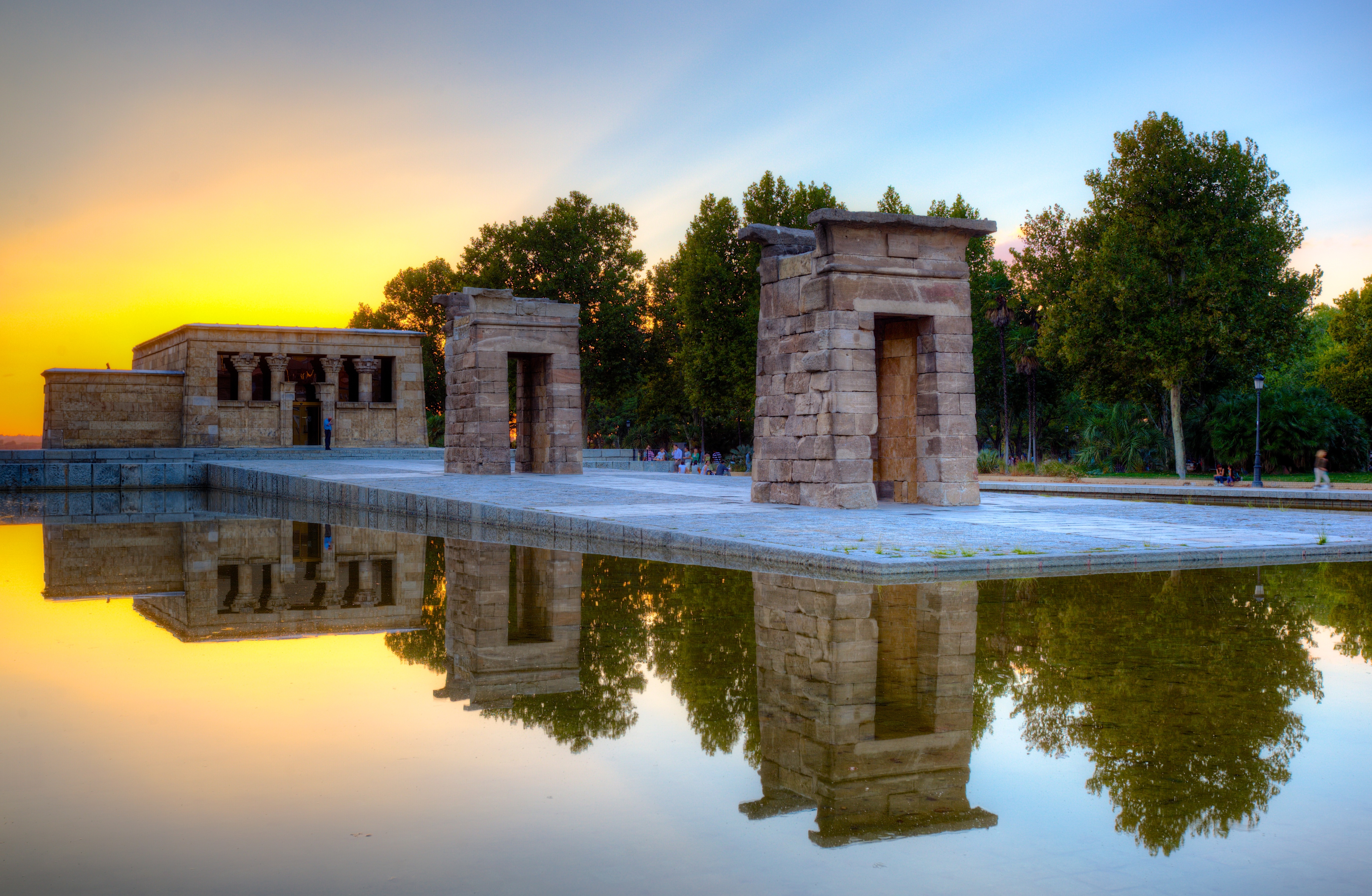
After sunset, head down to La Latina for dinner or drinks; the neighborhood comes alive with scores of tourists drinking alongside the countless bars and restaurants here, the atmosphere gets celebratory and these pictures would make for a great post.
The Royal Palace (Palacio Real) Spain’s Seat of Grandeur
Across town stands the Royal Palace, known locally as the Palacio Real, the official residence of the Spanish monarchs. Though the royal family no longer lives here full-time, the palace remains one of Europe’s largest and most lavish.
Highlights inside:
-
Baroque halls filled with chandeliers, frescoes, and royal portraits.
-
The Throne Room and Armory—two of the most photographed spaces in the Spanish capital.
-
Occasional classical concerts and temporary exhibits open to the public.
Walk through the Catedral de la Almudena beside it for a glimpse of more modern architecture and stained-glass light. When you step back outside, the sweeping courtyard offers the perfect spot to people watch as guards change shifts or tour groups gather.
Traveler tip: Book tickets online in advance to skip queues and enjoy a quieter morning visit.
Palacio de Cibeles & Plaza de Cibeles. Views from Above
A short metro hop east brings you to another architectural jewel: the Palacio de Cibeles. Once the city’s post office, it’s now Madrid’s city hall—and one of its finest examples of early-20th-century design.
Why visit:
-
Climb to the rooftop terrace for a sweeping panoramic view of Gran Vía and beyond.
-
Enjoy coffee at the rooftop bar inside the palace, a local favorite for sunset drinks.
-
Admire the fountain at Plaza de Cibeles, one of Madrid’s defining landmarks.
From here, you’re minutes away from Puerta del Sol and Plaza Mayor, the historic heart of the city—ideal for a leisurely stroll through history.
Hidden Green Corners: Príncipe de Anglona Gardens

Tucked between royal grandeur and urban bustle lies one of Madrid’s quietest hidden gems: the Príncipe de Anglona Gardens. Dating back to the 18th century, these walled gardens remain a secret even to many locals.
Why go:
-
Symmetrical box hedges, rose bushes, and stone paths that invite reflection.
-
Benches shaded by magnolias—perfect for reading or journaling away from crowds.
-
Free entry and open year-round.
It’s a rare pocket of serenity in the city center, offering a different kind of royalty: stillness.
Why This Route Feels Like Time Travel
From the Nile-born stones of the Temple of Debod to the chandeliers of the Royal Palace, Madrid’s history isn’t locked in museums—it’s woven through its streets and plazas. Each site offers a new rhythm: a sunset glow, a baroque echo, a hidden garden path.
And if you take the time to slow down and wander between them, you’ll discover that Madrid’s greatest luxury isn’t its grandeur—it’s how effortlessly the past and present share the same view.
Tastes of Tradition: From San Ginés to Mercado de San Miguel
If the royal palaces show Madrid’s grandeur, its cafés and taverns reveal its soul. Food here isn’t just a meal—it’s an act of memory. You can still taste recipes written centuries ago, sipped under the same arches that once sheltered poets and politicians. For anyone exploring Madrid Spain, a few sweet and savory traditions belong on every traveler’s list.
San Ginés: The Sweet Beginning

Hidden in a narrow lane beside Puerta del Sol, Chocolatería San Ginés has served churros con chocolate since 1894. Locals crowd the marble tables late at night, dipping golden spirals into cups of thick, molten chocolate before catching the last metro.
Why go:
-
A ritual that defines breakfast and post-party recovery alike.
-
Open 24 hours — it’s a rite of passage for visitors who love Madrid after dark.
-
The same recipe has survived three monarchs and countless revolutions.
Order one serving of porras (thicker churros) to share; the chocolate is rich enough to count as dessert.
Restaurante Sobrino de Botín: History on a Plate
Just steps from Plaza Mayor stands Restaurante Sobrino de Botín, officially the world’s oldest restaurant, certified by the Guinness World Record. Founded in 1725, it still roasts meat in the original wood-fired oven.
What to try:
-
The signature roast suckling pig, crisp skin giving way to tender layers of pork.
-
Traditional Castilian dishes like garlic soup or lamb asado.
-
The same dining room once favored by Ernest Hemingway, who called it “the best meal in town.”
Despite its fame, the service remains disarmingly simple — wood tables, tiled walls, and that unmistakable aroma of slow roasting that greets you at the door.
Mercado de San Miguel: Where Old Meets New
Around the corner from Plaza Mayor, the iron-and-glass Mercado de San Miguel bridges past and present. Built in 1916 and revived a century later, it’s Madrid’s most photogenic food market, offering every flavor of the Spanish capital under one roof.
Why visit:
-
Sample tapas from Michelin-recognized chefs without white-tablecloth formality.
-
Pair oysters with cava or jamón ibérico with vermouth from local vendors.
-
Perfect stop on a self-guided food tour through the city center.
Local restaurants nearby: Casa Revuelta (for cod fritters) and Los Galayos (for classic tortilla) keep the old-Madrid flavor alive just outside the market doors.
Why Tradition Still Tastes Fresh
Between the sweetness of San Ginés, the aroma of Botín’s oven, and the buzz of Mercado de San Miguel, you can taste centuries of continuity. These aren’t nostalgic museum pieces—they’re living institutions that still set the city’s rhythm.
Whether you come for delicious food, people-watching, or simple curiosity, you’ll leave with a sense that in Madrid Spain, the past is always served warm.
If the Jamón is calling to you and you need to stay back in Madrid for longer, it wouldn't be your fault. Find fully furnished apartments in Madrid on RentRemote to make sure that you're near Madrid’s best food markets and live within walking distance of these timeless flavors.

Culture Meets Curiosity: From Las Ventas to World-Class Museums
If you’ve already ticked off the Royal Palace and Plaza Mayor, it’s time to experience the artistic pulse that keeps Madrid alive. This is a city where matadors, painters, and visionaries share the same creative stage. From the legendary Las Ventas Bullring to cutting-edge art hubs and world-class museums, Madrid rewards the curious traveler who loves contrasts—tradition colliding with reinvention.
Las Ventas Bullring, A Cultural Icon
Built in 1929, the Las Ventas Bullring remains one of Spain’s most recognizable landmarks and an architectural marvel. Even if you’re not a fan of bullfighting, the building itself is worth exploring for its Moorish arches and detailed mosaics.
Why go:
-
Take a guided tour through the arena’s stands and underground passages to learn about Spanish culture beyond the spectacle.
-
Visit the onsite museum, which documents the art, history, and controversy surrounding the sport.
-
Step outside afterward to explore La Latina, where lively cafés and tapas bars showcase a gentler rhythm of local life.
Fun fact: The arena occasionally hosts concerts and fashion shows—proof that this 20th-century monument still knows how to draw a crowd.
Matadero Madrid, Where Industry Meets Art
Down by the Manzanares River, Matadero Madrid transforms a former slaughterhouse into a thriving hub of contemporary art and design. Industrial red-brick halls now host film screenings, architecture fairs, and avant-garde performances.

Why visit:
-
Free exhibits and experimental projects year-round.
-
Great coworking spaces and cafés that attract young creatives.
-
A perfect detour for anyone working remotely who craves inspiration between deadlines.
Traveler tip: Stop by in the evening—terraces here are a great place to unwind and watch locals mingle under string lights.
Museums That Define the Spanish Capital
Madrid’s Prado Museum, Reina Sofia, and Thyssen-Bornemisza form the city’s famed “Golden Triangle of Art.” Each reveals a different side of Spanish identity and global influence.
Highlights:
-
Prado Museum – Works by Velázquez, Goya, and El Greco bring the city’s rich history to life.
-
Reina Sofía – Home to Pablo Picasso’s masterpiece Guernica, a sobering reminder of Spain’s modern past.
-
Thyssen-Bornemisza – A bridge between classical and pop art, perfect for a slower afternoon visit.

If you’re an art lover, these three institutions are a few interesting things that deserve a permanent spot on your bucket list.
Insider tip: Skip weekends and visit on weekday evenings when entry to the Prado Museum is free for the final two hours.
More Creative Stops Off the Beaten Path
-
Cine Doré – A restored art deco theater screening independent films.
-
Mercado de Motores – A vintage market inside the Railway Museum, mixing retro stalls with live jazz.
-
Museo Sorolla – A quieter stop north of the city center, celebrating light, family, and Mediterranean beauty.
-
**Bernabéu Stadium **(Real Madrid) – Tour the stands, trophies, and locker rooms of one of the world’s most beloved teams.
These spaces prove that creativity in Madrid isn’t limited to galleries—it thrives wherever passion meets place.
Why Culture Here Feels Alive
The magic of Madrid’s cultural scene lies in its variety. A morning exploring the Las Ventas Bullring can lead to an afternoon with Picasso, and an evening concert at Matadero Madrid. It’s a city that refuses to sit still—a living gallery shaped by people who paint, perform, and preserve their heritage all at once. Following the art is such a great guide to discovering parts of Madrid that is hidden behind layers of nuance that one can only recommend this tour so much.
For travelers and remote workers alike, this fusion of past and present makes the Spanish capital an endless source of inspiration.

Day Trip Ideas from Madrid for Your Next Trip — Toledo, Segovia & Beyond
One of the best parts about staying in Madrid Spain is how close it sits to some of the country’s most popular destinations. A short train ride in almost any direction delivers centuries of art, architecture, and landscapes that feel far removed from the bustle of the city center. For remote workers or slow travelers, these easy getaways offer the perfect blend of inspiration and pause—a chance to see Spain’s heartland without leaving your comfort zone.
Toledo: The City of Three Cultures
A short, scenic journey from Puerta del Sol, Toledo is where Christian, Jewish, and Muslim influences blend seamlessly. Once the capital of Spain, it’s a living museum of beautiful architecture and layered rich history.
Why go:
-
Explore narrow medieval lanes leading to old churches and artisan sword shops.
-
Visit the hilltop Alcázar for sweeping views over the Tagus River.
-
Try local marzipan—Toledo’s sweetest claim to fame.
Pack a day’s worth of curiosity and comfortable shoes; every corner reveals a few interesting things worth lingering over.
Segovia: The Roman Masterpiece
Just over an hour from Madrid by train, Segovia charms visitors with its postcard skyline dominated by the Roman aqueduct—a feat of engineering dating back to the 1st century AD.
Highlights:
-
Walk beneath the 160 arches of the aqueduct, perfectly preserved without mortar.
-
Visit the fairy-tale Alcázar castle, said to have inspired Walt Disney’s Cinderella design.
-
Enjoy cochinillo asado (suckling pig) at one of Segovia’s traditional taverns.
Bucket list moment: Stand at sunset by the aqueduct when golden light hits the stones—proof that some of the most unique things in Spain are born from ancient ingenuity.
El Escorial & Valle de los Caídos: Power and Reflection
For travelers intrigued by royal legacy, El Escorial—the grand monastery and palace complex commissioned by King Philip II—is essential. The site houses centuries of Spanish monarchs and art collections rivaling smaller world-class museums.

Why go:
-
See the Pantheon of Kings, one of Europe’s most solemn royal burial chambers.
-
Tour fresco-lined halls where scholars once worked beneath marble domes.
-
Take a quick bus detour to Valle de los Caídos (Valley of the Fallen), a controversial memorial that prompts reflection on Spain’s modern past.
Cuenca & Aranjuez: Quiet Corners for Nature Lovers
When you crave calm, Cuenca and Aranjuez deliver. Cuenca’s “hanging houses” cling dramatically to cliffs above the Huécar River, a great place for photographers and nature lovers. The Aranjuez, meanwhile, charms with Renaissance gardens, royal fountains, and music heritage from the Teatro Real Carlos III de Aranjuez—home to Joaquín Rodrigo’s famous Concierto de Aranjuez.
Why go:
-
Perfect for a slow stroll by the Manzanares River on your return.
-
Less crowded than Toledo or Segovia but equally rich in beautiful architecture.
-
Both towns are UNESCO sites—ideal if you want authentic escapes off the beaten path.
How to Plan These Short Escapes
-
Timing: Each destination works as a full-day or overnight visit, easily reachable by AVE train.
-
Local tip: Purchase a Renfe Spain Pass for flexible travel within a week.
-
Connection: High-speed lines make Toledo and Segovia commuter favorites for long-weekend travelers and digital nomads alike.
Each of these day trips (or rather, unforgettable mini-adventures) adds a new color to your Madrid story. Whether it’s a bucket list moment under the Roman aqueduct or a quiet lunch in Toledo, these nearby towns remind visitors why Madrid remains the perfect base to visit Spain—connected, cultural, and endlessly curious.

Hidden Corners Locals Love: Parks, Pastries & Small Pleasures
Madrid’s magic often hides in plain sight. Beyond the grand museums and famous plazas, you’ll find quiet gardens, tucked-away bakeries, and rooftops where the skyline feels close enough to touch. These hidden gems reveal the local rhythm of everyday life—slow mornings, long sunsets, and a city built as much for pleasure as productivity.
Panem Bakery, The Cube Croissant Phenomenon
Among Madrid’s newest obsessions, the cube croissant from Panem Bakery has achieved cult status. Each week brings a different flavor—pistachio, dulce de leche, or seasonal fruits—and queues form early outside its minimalist storefront in the Chamberí district.
Why go:
-
Perfect spot for remote workers craving a caffeine break between emails.
-
The pastry layers are impossibly crisp, balanced with just the right sweetness.
-
It’s one of those unique things you can only find in Madrid.
Nearby stop: The Sorolla Museum—once the home of painter Joaquín Sorolla—offers a serene garden and light-filled galleries that pair perfectly with a slow morning.
Sweet Secrets, Cookies from the Cloistered Nuns
A tradition few visitors stumble upon: buying handmade cookies from cloistered nuns hidden behind the convent walls. Knock softly at the turntable window of Monasterio del Corpus Christi de las Carboneras near Calle del Codo. A quiet voice will ask what you want, and a small door will slide open, revealing tins of polvorones and almond biscuits.

Why go:
-
A centuries-old ritual that connects you directly to local heritage.
-
Cash-only and delightfully analog—no signs, no labels, just trust.
-
Proof that sometimes the sweetest discoveries don’t come from a food market.
Pair them with an espresso from Cafetería Cervecería la Villa nearby for an old-Madrid style morning.
Siete Tetas Park: Sunset on the Seven Hills
Officially called Parque del Cerro del Tío Pío, locals affectionately call it Siete Tetas Park (“Seven Boobs Park”) for its rolling hills that overlook the skyline. It’s one of Madrid’s best places for sunset—when the rooftops, towers, and distant mountains blush pink in the fading light.
Why go:
-
Popular with runners, couples, and anyone chasing panoramic views.
-
Bring a picnic and find your own quiet hill—each offers a slightly different angle of Madrid’s horizon.
-
If you’re lucky, a busker might be playing guitar as the sky shifts from gold to violet.

For a contrasting view, stop by a rooftop bar later in the evening—try Azotea del Círculo de Bellas Artes or Picalagartos Sky Bar for live music and drinks above the twinkling streets.
Parque del Capricho, Madrid’s Romantic Refuge
Hidden in the northeast corner of the capital, Jardin del Capricho is one of Madrid’s most atmospheric parks. Built in the 18th century for the Duchess of Osuna, it mixes neoclassical temples, shaded labyrinths, and sculptures that nod to myth and melancholy.
Why go:
-
Less crowded than Retiro but equally elegant.
-
Perfect for an easy stroll among peacocks and stone bridges.
-
Features one of Madrid’s most unique buildings—a wartime bunker used during the Civil War, open to visitors on weekends.
Local insight: Visit early in spring when almond trees bloom and fill the air with fragrance; it’s a photographer’s dream.
Quinta de los Molinos, Spring’s Quiet Spectacle
Come March, Quinta de los Molinos Park turns pale pink as its 1,500 almond trees burst into bloom. For nature lovers, it’s one of Madrid’s most photogenic corners, rivaling Japan’s cherry blossom parks.
Why go:
-
Free entry and easy metro access from Suanzes station.
-
Ideal spot for remote workers looking to recharge in nature.
-
Combine it with a visit to nearby Reina Sofía for a day that blends art and air.
Small Pleasures That Define Local Life
-
Morning coffee at HanSo Café in Malasaña.
-
Watching kids chase pigeons in Plaza de la Villa de la Reina.
-
Evening tapas in La Latina, where conversation spills from bar to bar.
-
Catching a Real Madrid match at Bernabéu Stadium with locals.
-
Spotting the strawberry tree, Madrid’s symbol, on the city’s coat of arms at Puerta del Sol.
Each of these moments proves that the city’s charm lies not only in its monuments, but in its habits—the little details that make daily life feel cinematic.

Explore our neighborhood guides to find stays near Madrid’s most authentic parks, cafés, and rooftops— start with La Latina where every day feels like a local adventure.
Visit Madrid with Curiosity
To truly visit Madrid, skip the itineraries and follow your instincts. Between Plaza Santa Ana and Plaza de Cibeles, every corner hums with life—art at Reina Sofía, market tastings at Mercado San Miguel, or long evenings filled with delicious food and good company. From the strawberry tree at Puerta del Sol to the laughter spilling through La Latina, this popular destination thrives on moments, not monuments.
Whether it’s dinner at the oldest restaurant in the world or cheering for Real Madrid, every experience reminds you why the capital belongs on every bucket list. Exploring Spain? Browse fully furnished apartments in Spain that come preinstalled with high speed WiFi and ergonomic desks.