Sophia
Wellbeing & Living Editor ·
Carabanchel is the neighbourhood most Madrid visitors never see and most long-term residents quietly move to after their first year. Located southwest of the city centre, it runs cheaper than Malasaña, calmer than Lavapiés, and more Spanish than either. The trade-off is real: you are further from the postcard version of Madrid Spain, and the tourist infrastructure is thin. That is mostly the point. This guide covers what it actually costs to live here, which parts of the Carabanchel district to avoid, and what the neighbourhood delivers for remote workers doing serious work.
Monthly rent ranges and what you get for the money in 2024
Where to work: coworking spaces, cafés with WiFi, and the quiet corners
Getting around on the Madrid Metro, buses, and BiciMAD bikes
Food, markets, and where locals actually eat in the Carabanchel neighbourhood
Culture, the Vista Alegre area, and what passes for nightlife here
Honest comparison against other Madrid districts for remote workers
What Carabanchel Madrid Actually Costs
Carabanchel is where the Madrid Spain rent gap becomes real money. A furnished studio in Malasaña runs €900–€1,100 a month. The same studio in Carabanchel runs €600–€750. That €300 difference is €3,600 a year before you've touched a grocery bill.
Rental Prices by Apartment Type
The range here is tighter than in central Madrid Spain — landlords know the market, but the ceiling is genuinely lower.
Furnished studios: €550–€750/month — older buildings, typically 30–45m², often with a separate kitchen
1-bedroom apartments: €700–€950/month — larger than equivalent central options, often with a terrace on higher floors
2-bedroom shared flats: €400–€550/person/month — common among Spanish university students, which means flexible lease terms
Calle Opañel and surrounding streets — the quietest residential pockets, best for longer stays
If you are coming from a city like Barcelona or London and looking for furnished apartments in Madrid, Carabanchel is the district where the budget arithmetic actually works out without the commute penalty you would expect.
Day-to-Day Spending
The Menú del Día pricing in Carabanchel is consistently €10–€12 — that is €2–€4 less per lunch than in La Latina or Gran Vía, and the quality is not worse, just less photographed.
Groceries at Mercadona Carabanchel — weekly basket around €40–€50 for one person cooking most meals
Coffee at local bars: €1.20–€1.50 for a café con leche — not specialty, but not bad
Madrid Metro monthly pass: €54 — covers the full network including the rides into the centre
Utilities typically included in furnished rentals, or €60–€80/month if separate
The honest monthly budget for a solo remote worker in Carabanchel — rent, food, transport, occasional going out — lands between €1,200 and €1,600. In Salamanca, that same lifestyle runs closer to €2,200.
Compared to the centro de Madrid, a one-bedroom flat in Carabanchel runs roughly €300 to €400 less per month — a difference that adds up to over €4,000 a year staying in your pocket.
Browse fully furnished apartments in Madrid to see what's currently available in the Carabanchel neighbourhood and surrounding districts.
Carabanchel Neighbourhood: Which Part to Actually Live In
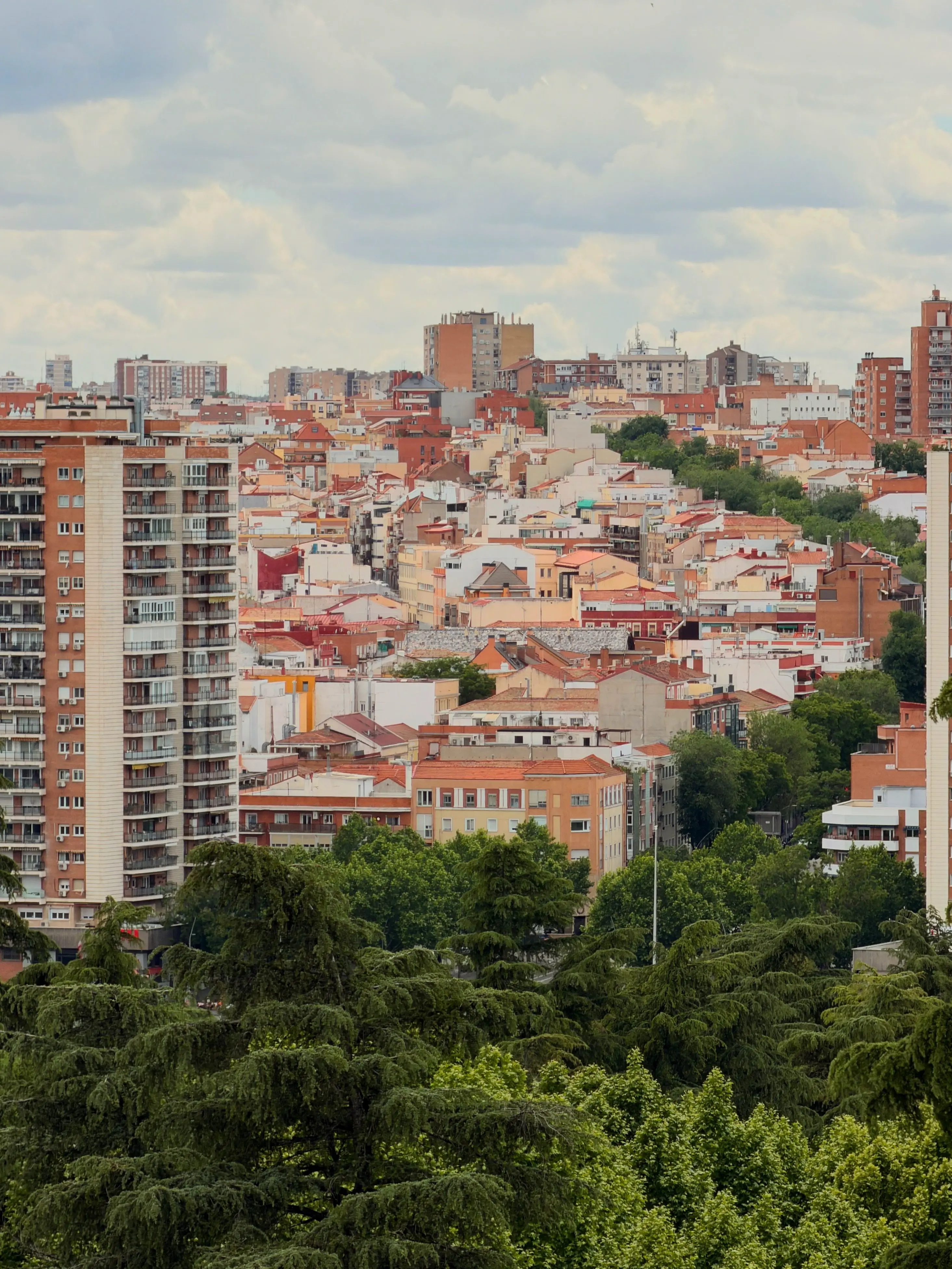
The Carabanchel district covers a lot of ground — and not all of it is equally liveable for someone working remotely. The northern edge near Plaza Vista Alegre is the part most remote workers gravitate toward: better transport links, more cafés, and the Palacio Vistalegre arena nearby keeps the street life active without tipping into noisy.
Vista Alegre: The Practical Core
Vista Alegre is the commercial heart of Carabanchel — the metro stop, the market, the banks — and it works precisely because it is designed for residents, not visitors.
Mercado Municipal Puerta Bonita — fresh produce, butchers, cheese stalls; open Monday–Saturday mornings, best before 11am
Metro Line 5 stop right on the plaza — 15 minutes to Puerta del Sol without changing trains
Half a dozen Spanish bars within 200 metres — menú del día from €10, no English menus, no tourists
Quieter by 10pm on weekdays — good if you keep European time zones, limiting if you do not
Vista Alegre rewards the kind of remote worker who wants a neighbourhood that functions, not one that performs.
Browse Madrid homes near this area
San Isidro: The Quieter Bet
San Isidro — the historic heart of Carabanchel — is named for Madrid's patron saint and sits slightly east toward the river; it is residential in a way that makes Vista Alegre look busy.
Parque Pradolongo — a proper local park, used by families and dog walkers, good for a midday break without the El Retiro Park weekend crowds
Older building stock — larger floorplans than equivalent prices elsewhere, but verify WiFi infrastructure before signing
The San Isidro festival in May transforms the area — worth experiencing once, loud for about four days
Few cafés with laptop-friendly setups — you are working from your apartment or commuting to a coworking space
San Isidro is the right call if solitude and low cost matter more than walkable infrastructure — but know what you are giving up.
If you want the neighbourhood's most walkable core — with the metro, the market, and the best terrace bars all within five minutes — the Comillas Opanel pocket around Calle Opanel and Plaza de Comillas is where you should be searching first.
Neighbourhood | Monthly Rent (Studio) | Vibe | Best For | Key Advantage |
|---|---|---|---|---|
Vista Alegre (Carabanchel) | €600–€750 | Residential, functional | Budget-conscious remote workers | Metro Line 5, local market, real Spanish community |
San Isidro (Carabanchel) | €550–€700 | Quiet, working-class | Long stays, low distraction | Lowest rents in Madrid proper |
Lavapiés | €750–€950 | Multicultural, noisy evenings | Social remote workers | Central, walkable to most of Madrid |
Malasaña | €900–€1,100 | Trendy, café-heavy | Shorter stays, coworking crowd | Best café infrastructure in Madrid |
Salamanca | €1,100–€1,500 | Upscale, quiet | Higher-budget professionals | Best residential quality, closest to Retiro |
Explore other Madrid neighbourhoods in our neighbourhood guide for a deeper breakdown of streets, building quality, and what each part of the district feels like on a Tuesday afternoon.
Browse Madrid homes near this area
Getting Around: Travel on All Buses and BiciMAD Bikes
Carabanchel is not a walking neighbourhood in the way that central Madrid Spain is — the city's density thins out here, and distances between points stretch. The good news is that the public transport coverage is solid, and if you set it up properly in your first week, you stop thinking about it.
Travel on All Buses and Bicimad Bikes: The Ground-Level Options
The Madrid Metro covers the district well enough that most remote workers use it as a primary commute tool, but the surface options fill real gaps.
Madrid Metro Line 5 (Carabanchel stop, Vista Alegre stop, Oporto stop) — the spine of the district, 15–18 minutes to Sol
Madrid Metro Line 11 runs along the western edge — less useful for central Madrid, good for reaching Cuatro Caminos without changing
Buses and BiciMAD bikes complement the metro for east-west movement within the district — the grid streets make cycling straightforward
BiciMAD docking stations on Calle Eugenia de Montijo — first 30 minutes free with the annual pass (€25/year)
Bikes on and September through November are the best months for cycling in Madrid — the heat breaks, the streets are drier than winter, and the traffic on surface roads is predictable.
Getting Into Central Madrid
The central question for anyone based in Carabanchel is how the commute feels after week three — and the honest answer is that it becomes invisible.
Puerta del Sol in 15 minutes on Line 5 — the same journey from Malasaña on foot takes 20 minutes and costs you energy
Monthly Madrid Metro pass: €54 — covers unlimited rides on metro and EMT buses, valid on all lines
Night buses (Búhos) run from Puerta del Sol to Carabanchel after metro closes at 1:30am — the N16 covers the main corridor
Taxi or Cabify back from the centre: €8–€12 depending on time — cheaper than the equivalent trip from Salamanca
The distance from Carabanchel to the centre is real, but the transport infrastructure makes it a 15-minute problem, not a lifestyle problem.
Alternative Madrid: Culture, the Palacio Vistalegre Arena, and What This District Actually Offers
Carabanchel is not the first answer anyone gives when you ask about Madrid art galleries or alternative Madrid cultural scenes — but that is partly because the conversation about Madrid culture tends to start and end in the same three central postcodes. The district has more going on than its reputation suggests, and none of it requires competing with tourists for space.
Palacio Vistalegre JPG: The Anchor Venue
The Palacio Vistalegre arena sits at the northern edge of the Carabanchel neighbourhood and pulls serious acts — boxing, concerts, theatre — that give the area a pulse it would not otherwise have on weekends.
Palacio Vistalegre — mid-size arena, 15,000 capacity, check listings before committing to a month here; a big show weekend changes the street energy completely
Bars and restaurants on Calle Vía Lusitana fill before and after events — better food than equivalent venue strips elsewhere in Madrid Spain
The arena is 400 metres from the Vista Alegre metro stop — no taxi required, no transport planning
Quieter in summer — August programming is light, which matters if you arrive then and wonder why nothing is happening
The Palacio Vistalegre arena is not the reason to move to Carabanchel, but it is a reliable answer to the question of what you do on a Friday when you do not want to navigate the centre.
Wikimedia Commons holds a substantial archive of media related to Carabanchel's architectural heritage, including photographs of the demolished prison that are sharper and more extensive than anything published in mainstream Madrid travel guides.
Madrid Art Galleries and Local Culture
The madrid art galleries that matter to most remote workers are not in Carabanchel itself — they are a metro ride away — but the district has its own cultural layer that the centre does not replicate.
El Cubo — small contemporary space in the barrio, free entry, rotating local Spanish artists, open Thursday–Sunday
Centro Cultural Usera — community centre running Spanish language workshops, cinema nights, and local exhibitions; information on programming posted at the entrance weekly
Street murals along Calle Carabanchel Alto — this is alternative Madrid in the literal sense, documentary-quality work on working-class history
The Feria de San Isidro grounds — the festivity area used every May for the patron saint celebrations, open as a park the rest of the year
The original prison walls of the Cárcel de Carabanchel were demolished in 2008, but the site near Avenida de los Poblados still draws architects and historians who consider it one of Franco-era Madrid's most significant lost buildings.
The Palacio de Vargas and the old Carabanchel Prison both appear prominently in Wikidata pages using location data tied to Madrid's southern districts, reflecting how seriously historians now document this neighbourhood's layered past.
Getting Around: Carabanchel's Transport Links and Day-to-Day Mobility
Carabanchel district is not isolated — it just feels that way until you learn how the metro grid actually works here, and then it stops feeling isolated at all.
Madrid Metro Access from Carabanchel
Line 5 does the heavy lifting, but the district has more entry points than most newcomers realise, which changes how you think about which sub-area to rent in.
Metro Carabanchel (Line 5) — direct to Gran Vía in 12 minutes, Callao in 14; no changes required during peak hours
Metro Oporto (Line 5) — quieter station than Vista Alegre, useful if you are renting on the western edge of the district near Comillas o Panel
Metro Eugenia de Montijo (Line 5) — the stop most people overlook; faster access to Nuevos Ministerios than going via Sol
Cercanías connections at Estación Laguna — if you need the aeropuerto, this line is often faster than changing at Nuevos Ministerios and cheaper than a cab
The Metro Line 5 stops at Comillas, Oporto, and Panel — three stations that between them cover most of central Carabanchel and put Sol reachable in under 18 minutes without changing trains.
The Madrid Metro monthly pass is €54 regardless of where you live in the city — but from Carabanchel, that €54 buys you a commute that does not require a transfer, which is not something Usera or the outer south can always claim.
Cycling and Walking Infrastructure
Carabanchel is not a cycling district in the way that Chamberi or the Retiro ring road are, but it is more walkable within itself than the grid suggests from a map.
Paseo de las Acacias connection — flat route north toward La Latina on bike; no hills until you hit the old city edge
Casa de Campo entry at Puerta del Ángel — 25 minutes cycling from Puerta Bonita into one of Europe's largest urban parks; the bike lane runs alongside the Manzanares river
De los Rosales to Comillas o Panel on foot — 18 minutes, fully flat, past the local market strips that are actually useful rather than decorative
If you are working a standard remote schedule and only need to move twice a day, Carabanchel's pedestrian geometry is fine — the friction is real only when you are running errands across the whole district, which you rarely need to do.
The Carabanchel District in Context: What the Wider City Offers
Living in Carabanchel district means you are not in the centre — but Madrid es a city where the centre is fifteen minutes away by metro, which reframes what "not central" actually costs you.
What You Can Access in Under 20 Minutes
The things people move to Madrid for — the food, the late nights, the museums, El Retiro Park on a Sunday — are all within metro range, not walking range, and that distinction matters less than it sounds.
El Rastro market — La Latina, Sunday mornings; 15 minutes on Line 5, no changes; arrive before 11am or the stalls worth visiting are already picked clean
El Retiro Park main entrance — 18 minutes by metro; free to enter, and significantly less crowded on weekday mornings than the tourist literature implies
Taberna La Bola — Chamberi, for cocido madrileño; €18 for the full set; book 48 hours ahead or accept a queue on Saturday noon
Paseo de la Castellana — 20 minutes by metro for business meetings or coworking spaces concentrated in the Azca district; useful if your work intersects with corporate Madrid
You will lose the spontaneity of stepping out of your flat and being in the middle of everything — but you gain the ability to choose when you engage with the city, which is a different, more sustainable relationship with Madrid es than most short-term visitors ever develop.
Carabanchel Prison: History You Cannot Ignore
The carabanchel prison site is the single most historically significant landmark in the district, and understanding what it was changes how you read the neighbourhood's character.
The former Carabanchel prison site on Calle Camino Viejo de Leganés — demolished in 2008, now a residential development; the ghost of it is still in the street names around the plot
The carabanchel prison operated from 1944 to 1998 under Franco and then the democratic government; its history is documented in the Archivo Histórico de Madrid, a 20-minute metro ride away in Salamanca district
Santiago Bernabéu and the carabanchel prison are both symbols of 20th-century Madrid — one celebrated, one deliberately erased; locals have strong views on which deserved the treatment it got
The isidro vista area around the former site now has social housing and a primary school — the land was never privatised, which is genuinely unusual in the madrid es property context of the 2010s
The En Wikipedia article on Carabanchel is more detailed than most English-language travel guides and includes a full breakdown of the district's six barrios, which is essential context before you decide which specific street to focus your apartment search on.
This is the hidden layer of Carabanchel that no amount of café research will reveal — the district's politics are written into its streets, and you will understand its residents better once you know what stood here.
Neighbouring Districts: What Usera and Puerta Bonita Add
Usera borders Carabanchel to the east and is worth knowing about because it adds an entirely different food and commercial infrastructure within walking distance that the district itself does not supply.
Calle General Ricardos — the main artery connecting Carabanchel to Usera; Chinese supermarkets, Vietnamese restaurants, and a produce market density that undercuts even the local Mercadona pricing
Es Vietnam Restaurant — Usera, bowl from €7, open for lunch and dinner; the most functional daily eating option within 10 minutes of the Puerta Bonita metro area if you are bored of Spanish menus
Puerta Bonita itself — a sub-barrio within Carabanchel district proper, quieter than Vista Alegre, with its own small commercial street that serves residents who want nothing to do with the metro crowds
Alameda de Osuna and the northern edge of the Manzanares park are technically further — 30 minutes by bike from de Campo — but worth knowing exist when you have a free afternoon and no work deadlines
Any short description of Carabanchel that leaves out its working-class Castilian identity and its large Moroccan and Latin American communities is painting an incomplete picture of what actually makes the district tick.
A short description of Carabanchel as a "working-class southern suburb" undersells it — the district now has more independent restaurants per block on Calle Opanel than most of Malasaña.
Finding an Apartment in Carabanchel: What to Know Before You Search
The rental market in Carabanchel district moves faster than the listings suggest — units that are priced correctly are gone within 72 hours, and anything that sits for a week usually has a reason.
Where to Focus Your Search
The difference between a good and a mediocre Carabanchel apartment is often which street it is on — not the apartment itself, but what the street gives you access to at 8am on a Tuesday.
Calle Pradillo area — residential, quiet, 7-minute walk to Oporto metro; favoured by Spanish professionals; studios here list at €600–€700/month and rarely come with tourist-grade furniture
Avenida de Carabanchel Alto — the most connected spine of the upper district; 1-beds from €750/month, higher ceilings and older construction than the 1990s blocks nearer the metro
Comillas o Panel — the sub-barrio between Oporto and the Casa de Campo edge; cheaper than Vista Alegre by €50–€80/month; the trade-off is fewer ground-floor cafés, more residential silence
References from existing tenants in a building matter here more than the listing photos — the management quality of older Carabanchel buildings varies significantly, and that variance shows up in heating costs in January
Browse fully furnished apartments in Madrid with filters for Carabanchel district specifically — it saves the step of ruling out Salamanca-priced listings that appear when you search the city broadly.
Lease Terms and Furnished Availability
Short-term furnished supply in Carabanchel is thinner than in Malasaña — the district attracts longer-term renters, which means landlords are less practised at monthly contracts but more open to them if you ask directly.
Most furnished listings run three-month minimum terms; some landlords will accept one month for a premium of €50–€100 above the standard rate — worth it if you are testing the district before committing
Unfurnished long-term leases dominate the Spanish-language listings on Idealista; the furnished stock sits mostly on English-facing platforms and moves faster
Centro de Atención Ciudadana Carabanchel — the local district office handles empadronamiento (registration); you need this after 90 days for a Madrid library card, health centre access, and proof of address for banking
Avoid listings photographed in summer that show no heating equipment — Carabanchel winters are cold enough (Madrid es continental, not Mediterranean) that a flat without radiators or a heat pump is a problem from October through March
The furnished apartment market here rewards persistence over speed — the best units are not listed on day one, they circulate through networks and appear mid-week when the weekend browsers are not watching.
Most listing pages using filters on Idealista let you narrow Carabanchel apartments by metro distance, which is genuinely useful when comparing flats near Oporto versus those closer to Carabanchel station itself.
Is Carabanchel Right for You? An Honest Assessment
What Carabanchel Actually Costs You
Choosing Carabanchel is a trade — you give up proximity to the postcard version of Madrid and get back financial room to breathe.
Rent in Carabanchel runs meaningfully lower than Malasaña or Chueca for equivalent floor space and furnishing quality
The saving compounds across a three-month stay into something concrete — a month of runway, a flight home, the leverage to turn down bad work
You are not walking to the Prado on a whim, but the Metro makes it a deliberate twenty-minute trip rather than an impossible one
The central neighbourhoods are still accessible; they just stop feeling like the baseline you are paying to maintain
The price difference between Carabanchel and central Madrid is not a consolation prize — it is the reason the stay becomes sustainable rather than stressful.
The honest content of most expat forum threads about Carabanchel boils down to the same trade-off: you save €350 a month on rent but you add 20 minutes each way to any commute toward the city centre.
Who This Neighbourhood Is Actually For
Carabanchel rewards remote workers who have decided they are building a life in Madrid for three months or more, not sampling it for three weeks.
Long-stay workers who want financial margin over immediate convenience
People whose daily rhythm is laptop-first and neighbourhood-second — the district is quiet in a way that supports that
Anyone who has priced themselves out of Lavapiés or Malasaña and is looking for the honest alternative rather than a compromise
Remote workers who plan to renew — the district has a pattern of people who arrive planning to leave and don't
If you want Plaza Mayor on a whim, you are not in the wrong city, you are in the wrong neighbourhood — and that is a description, not a criticism.
How to Test It Before You Commit
Madrid tolerates experimentation, and Carabanchel is low-risk enough to try for a month before deciding anything.
Start with a one-month booking and treat it as a paid trial — if the commute to the centre feels like a burden rather than a boundary, you have learned something useful
Most people who run that experiment end up renewing south rather than moving to Chamberí
Filter fully furnished apartments in Spain by price range first — what you can afford in Carabanchel reframes whether anywhere else in Madrid makes financial sense
The Metro network means you can pressure-test the actual journey to wherever you spend your days before signing anything longer
The honest move is to let the numbers lead — once you see what Carabanchel costs against what it offers, the decision tends to make itself.