


















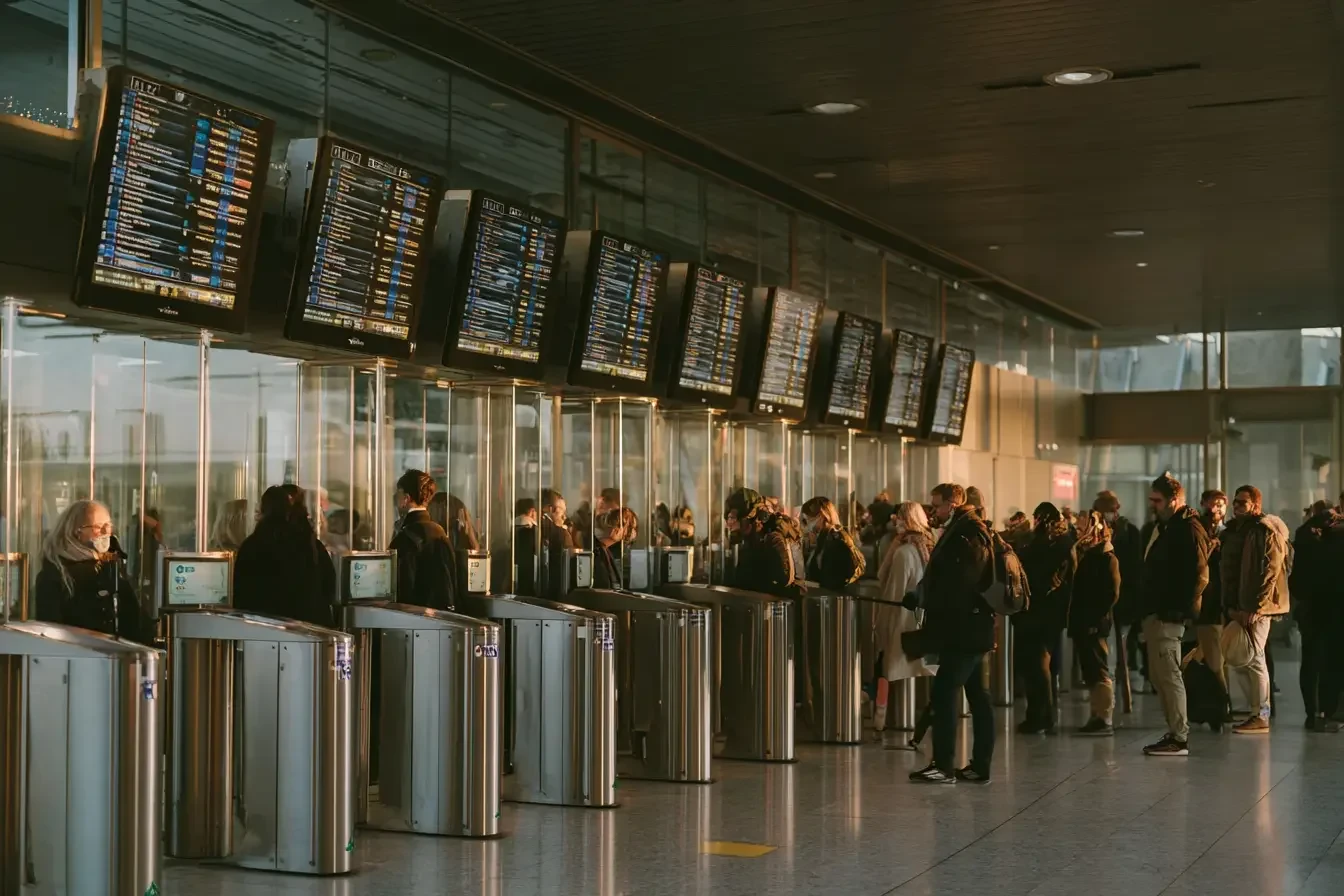
How to Navigate Schengen Airport Chaos This Summer: A Digital Nomad Survival Guide
EES biometric border checks are causing 2-3 hour delays at Schengen airports. Here is what digital nomads need to know to avoid missing flights this summer.
The EU Entry/Exit System (EES) went fully live on April 10, 2026, and the first weekend was a mess. At Milan Linate, 122 passengers missed an easyJet flight to Manchester. A UK-bound flight departed with 51 passengers missing. Another flight had zero passengers at the gate by closing time.
If you're a digital nomad planning to travel through Europe this summer, this isn't a minor inconvenience. It's a structural change that could derail your itinerary, cost you money, and leave you stranded at the gate. Here's what happened, why it's happening, and how to protect yourself.

What Went Wrong on April 10–12, 2026
The EES launched progressively in late 2025, but April 10, 2026 marked the first weekend of full operations across all entry points. The results were predictable to anyone who has ever watched a government IT rollout.
Confirmed Incidents
- easyJet EJU5420 (Milan Linate → Manchester): 122 passengers missed their flight after EES exit processing delays. The aircraft was held for about an hour before crew duty time limits forced departure.
- A UK-bound flight: Departed with 51 passengers still stuck in border control.
- Another flight: Had literally zero passengers at the gate by closing time.
- General chaos: Peak waits at airport immigration controls reached 2–3 hours during the Easter weekend rush.
These aren't outliers. ACI EUROPE, the trade association representing European airports, issued a joint statement with Airlines for Europe (A4E) calling for the full suspension of EES when waits become excessive. Their words: "Strengthening border management must not come at the expense of operational efficiency or the passenger experience."
The European Commission responded by claiming the average EES registration takes about 70 seconds and that the system is "operating well." They put responsibility on member states to staff heavy-traffic crossings properly. In other words: the software works, the people don't.
What the EES Actually Does
If you need a refresher on how the Entry/Exit System works, we covered the full guide here. In short: every non-EU citizen entering or leaving the Schengen zone now has their face and fingerprints scanned digitally. No more passport stamps. A centralized EU database tracks exactly how many days you've spent in Schengen.
The system has registered 45 million+ border crossings since launch, flagged 24,000+ refusals of entry, and identified 600+ people assessed as security risks. Those numbers suggest the system is doing its job for security. But for travelers, the cost is time.
Why Summer 2026 Will Be Worse
Easter weekend is just the warmup. Here's why July and August could be significantly worse:
Volume: Europe sees its highest tourist traffic in July and August. Airports that were already struggling with Easter crowds will face 2–3x the volume.
Staffing: Border agencies across Europe are already short-staffed. Summer leave rotations will thin the ranks further. The Commission says member states should staff up. History suggests they won't.
First-time registrations: Every non-EU traveler who hasn't used EES yet needs a full biometric registration (face + fingerprints). That's millions of first-time entries over summer. The 70-second average only applies to return visits.
No suspension mechanism: Despite industry calls for automatic suspension when queues become excessive, there's no agreed protocol for this. The Commission says it's "operating well." Airlines say it's breaking their networks. The disconnect is not being resolved before peak season.
What Digital Nomads Should Do Now
1. Add 3–4 Hours for Non-Schengen Departures
If you're flying out of a Schengen airport to a non-Schengen destination (UK, US, Asia, anywhere outside the zone), you need to clear EES exit processing. That's where the worst delays are happening.
Practical rule: For flights from Italian, Spanish, or Greek airports to non-Schengen destinations, arrive 4 hours before departure for the rest of summer 2026. For major hubs like Frankfurt, Amsterdam, or Paris CDG, 3 hours minimum.
This is especially important if you're connecting through a Schengen airport en route to somewhere else. A 90-minute connection that used to be comfortable is now risky.
2. Pad Your Connections
If you're booking multi-leg trips through Europe, build in more connection time than usual. A missed connection due to EES delays is technically not the airline's fault under most passenger rights frameworks, which means compensation may not apply.
Better approach: Book direct flights where possible for critical travel dates. If you must connect, allow 3+ hours between flights when the first leg arrives at a Schengen airport and the second departs from the same airport.
3. Book Flexible Tickets for Must-Be-There Travel
If you have a conference, a client meeting, or a property check-in that you absolutely cannot miss, book refundable or changeable tickets. The extra cost is insurance against a 3-hour EES queue making you miss a flight you can't afford to miss.
4. Keep Screenshots of Rebooking Offers
If EES delays cause you to miss a flight, airlines will sometimes offer rebooking on later flights. Take screenshots of everything: the delay announcement, your position in the queue, the rebooking offer, any compensation claims. If you need to dispute a charge or claim on travel insurance later, documentation matters.
5. Monitor Airport Social Feeds the Week You Travel
Most major European airports post real-time queue information on their social media accounts (primarily X/Twitter). Check these the day before and morning of your flight. If an airport is posting warnings about "long queues at passport control," believe them and leave earlier.
6. Consider Non-Schengen Routing
For some trips, routing through non-Schengen hubs can avoid EES entirely:
- Flying UK → Asia: Route through London Heathrow or Istanbul instead of connecting through Amsterdam or Frankfurt.
- Flying US → Eastern Europe: Direct flights to Dubrovnik, Tirana, or other non-Schengen Balkan destinations skip the system entirely.
- Flying within Schengen: EES only applies to entries and exits from the Schengen zone, not internal flights. Barcelona → Lisbon doesn't trigger EES. Barcelona → London does.
If you're based in a non-Schengen country for part of your summer (Turkey, Georgia, Albania, the UK, Ireland), keep in mind that time outside Schengen doesn't count against your 90/180 day allowance either. For a full breakdown of how the 90/180 rule works under EES, see our complete EES guide.
7. Know Your Passenger Rights
Under EU Regulation 261/2004, if your flight is delayed by more than 3 hours or canceled, you may be entitled to compensation of €250–€600 depending on flight distance. However, airlines may claim "extraordinary circumstances" for EES-related delays, which exempts them from compensation.
That said:
- The airline must still rebook you on the next available flight at no extra cost.
- If the delay is overnight, they must provide accommodation and meals.
- Keep all receipts. If the airline later acknowledges the delay was within their control, you can claim retroactively.
The key word here is may. EES delays occupy a gray area legally. Don't bank on compensation, but document everything in case it becomes available.
The Bigger Picture for Nomads
The EES isn't going away. This is the new normal for non-EU travelers entering and leaving the Schengen zone. What we're seeing in April 2026 is the predictable friction of a major system change during high-traffic periods.
For digital nomads, this means two things:
Europe is still accessible, but looser travel patterns are harder. The era of casually hopping between Schengen countries with a 90-day tourist stamp is functionally over. The system tracks you precisely. Overstays are no longer a matter of a border agent missing a stamp.
Digital nomad visas become more valuable. If you want to spend extended time in Europe without the EES hassle, a digital nomad visa in Portugal, Spain, Greece, Croatia, or another EU country exempts you from the 90/180 day limit entirely. You're a resident, not a tourist. No EES queues, no day counting, no border anxiety.
For nomads not ready to commit to a full visa, splitting time between Schengen and non-Schengen countries (Albania, Montenegro, Serbia, Georgia, Turkey) remains a viable strategy. Just track your days carefully.
What to Watch For
Several developments could change the situation over summer 2026:
- Industry pressure for suspension: ACI EUROPE and A4E have explicitly called for EES to be suspended when queues become excessive. If enough airlines and airports push, the Commission may be forced to create a temporary suspension mechanism.
- Staffing increases: Some member states may add border staff for summer. Others won't. The disparity between well-staffed airports (Amsterdam, Munich) and understaffed ones (parts of Italy, Greece) will likely widen.
- ETIAS launch: The European Travel Information and Authorization System (ETIAS) is scheduled to launch after EES stabilizes. Once active, non-EU travelers will need pre-authorization before boarding flights to Schengen. This could add another layer of bureaucracy, or it could smooth entry by pre-screening travelers. Watch for announcements.
Bottom Line
The EES rollout in April 2026 was messy. It will probably stay messy through summer. The question isn't whether you'll face delays — it's whether you're prepared for them.
Arrive earlier. Pad your connections. Book flexible tickets for critical travel. Keep documentation. And if you're spending more than a few months in Europe per year, look seriously at a digital nomad visa. The 90-day tourist shuffle was always a workaround. EES just made it a much less comfortable one.
Planning extended time in Europe? Browse work-ready apartments in Barcelona, Lisbon, and other nomad hubs on RentRemote.