



















Georgia Tax Guide for Digital Nomads: How to Pay 1% on Remote Income
How digital nomads can legally pay 1% tax on remote income in Georgia. Residency, small business status, banking, and cost of living guide.
Georgia has emerged as a compelling destination for people who want flexibility, favorable taxation, and a solid day-to-day lifestyle. Its residence rules are straightforward, taxes are low by international standards, and living costs remain reasonable relative to what the country offers.
This piece looks at how Georgia’s tax system and lifestyle combine to appeal to high-net-worth individuals who want to base themselves somewhere efficient without unnecessary complexity. The appeal is largely structural: simple rules, predictable outcomes, and room to optimize.
This content is informational only and not a substitute for professional tax or legal advice. It is meant to help you evaluate whether Georgia fits your broader strategy. For advice tailored to your specific situation, a personalized tax planning review is required.
Understanding Georgia's tax system requires attention to detail, and this article will provide detailed insights into the process to help you make informed decisions.
Introduction to Georgia’s Tax System
Georgia’s tax system is designed with simplicity and international competitiveness in mind, making it a standout choice for both individuals and businesses seeking to optimize their tax position. The country applies a flat tax rate of 20% on personal and corporate income, streamlining the process for taxpayers and reducing administrative burdens. For tax purposes, Georgia distinguishes between local and foreign source income—meaning that foreign earnings generated from business operations outside the country are exempt from Georgian taxation. This approach allows entrepreneurs and companies with international operations to benefit from significant tax savings, as only income sourced within Georgia is subject to local tax rates. The country’s tax authorities are responsible for ensuring compliance with these regulations, providing clear guidelines for businesses and individuals to follow. By exempting foreign source income from taxation, Georgia offers a compelling environment for those looking to maximize their earnings and minimize their tax liability while conducting business on a global scale.
Why live in Georgia?
Georgia sits at the crossroads of Europe and Asia, bordered by Turkey and Russia, and plugged into the European Union’s free trade area. Geography does much of the selling on its own: Black Sea coastline, the Caucasus mountains, dense forests, and established ski regions all within a small footprint.
The country blends old and new without trying too hard. Centuries-old churches and wine traditions coexist with a modern, technology-oriented capital in Tbilisi. Daily life supports both work and downtime, with beaches, casinos, outdoor sports, and a service economy built around long stays rather than short tourism bursts.
From a mobility and tax perspective, Georgia is unusually permissive. Citizens of many countries can enter visa-free and stay for up to one year. Its passport also provides access to over 120 countries. For registered independent entrepreneurs, the headline tax rate can be as low as 1%, which explains why Georgia keeps showing up in serious residency and tax-planning discussions.
How to Live in Georgia and Pay Zero or 1% Tax
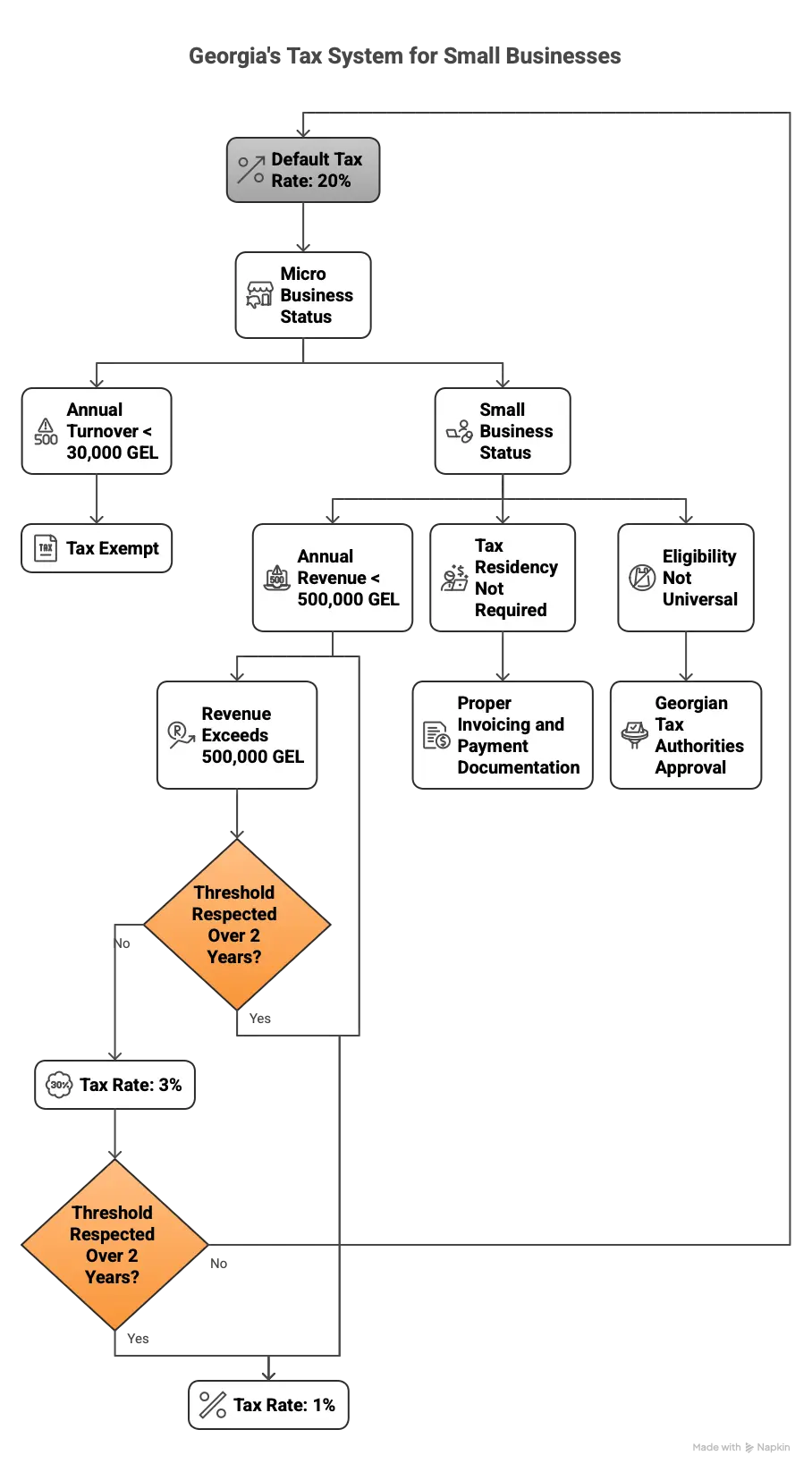
Georgia applies a flat 20% tax to personal income by default. That is the baseline. The system becomes more interesting once you look at the special regimes designed for small operators.
At the lowest tier, individuals with annual turnover below 30,000 GEL can register as a micro business with no employees. Business income under this status is exempt from tax. Above that, a separate regime applies. If annual revenue stays under 500,000 GEL, roughly USD 150,000, you can apply for small business status and pay a flat 1% on qualifying income.
Registration matters. You must file the correct forms and documentation to establish your tax position and eligibility. Income limits are monitored, but crossing the 500,000 GEL threshold does not trigger an immediate penalty. If revenue exceeds the cap, the regime can still remain in place provided the threshold is respected again over the following two years. When the 1% regime no longer applies, taxation shifts gradually to 3% or ultimately to the standard income tax rate rather than being revoked instantly.
Tax residency is not a prerequisite to benefit from small business status. This makes the system particularly attractive for freelancers and entrepreneurs relocating operations while maintaining international clients. Proper invoicing and payment documentation are essential to support non-local income classification. Foreign-source income earned by non-resident aliens is not subject to U.S. taxation, which is often a key factor in cross-border planning.
Eligibility is not universal. Certain activities, including many consulting services and employment-style arrangements, are excluded. The Georgian authorities maintain a defined list of permitted activities, and classification is enforced strictly. Contract wording and business descriptions must align precisely with approved categories. Final approval always rests with the Georgian tax authorities.
Other Options for Incorporating in Georgia
Limited Liability Company
Georgian LLCs are taxed under a distribution-based system. Corporate profit is taxed at 15% only when it is distributed. Dividends paid to individuals are then subject to an additional 5% personal tax. As long as profits remain inside the company, are reinvested, or are used to acquire stakes in other companies owned by the same entity, the effective tax rate is 0%.
This structure rewards reinvestment and long-term capital allocation rather than cash extraction. Companies that retain earnings or redeploy them internally defer taxation entirely until a distribution event occurs.
On top of that, LLCs may reduce their effective burden further through available incentives, including depreciation schemes and qualifying tax credits such as those linked to research and development activities. The result is a system that prioritizes business growth and capital efficiency over immediate taxation.
Specific tax provisions in Georgia govern the taxation of LLCs, including the timing and rates of both corporate and dividend taxes. Note: Eligibility for certain credits and the timing of tax payments may vary depending on the LLC's activities and compliance with local regulations.
Virtual Zone Company
Georgia offers a dedicated regime for certain IT businesses known as the Virtual Zone Company status. Companies that qualify pay 0% corporate profit tax, 0% VAT on services provided to foreign clients, and 5% tax on dividends when distributed. The standard VAT rate in Georgia is 18%, which makes this exemption material. Eligibility is limited to specific IT activities, and the benefits apply only when clients are located outside Georgia. The intent is clear: attract export-oriented technology companies while keeping operational substance in the country.
International Company Status
International Company Status is a separate, more operationally focused regime. Qualifying companies pay 5% profit tax, 0% tax on dividends, and a reduced 5% tax on employee salaries. This program targets companies that base real operations and staff in Georgia, primarily in IT and maritime sectors, including firms with qualifying divisions in those fields. The structure is designed to encourage job creation and long-term presence rather than passive structures, while keeping overall taxation low and predictable.
Why consider Georgia for business incorporation?
-
Cheap setup and maintenance costs, with reduced ongoing expenses for businesses operating in Georgia, including lower tax expenses due to available tax credits, deductions, and favorable provisions. For a self employed individual or those operating within a small partnership, Georgia offers an attractive environment to manage your business independently, focusing on innovation and personal customer service. Approximately 80% of small businesses are managed solely by their founders, and over 80% of businesses in the U.S. are independently run, highlighting the prevalence of independent business ownership.
-
Reputation as a reputable jurisdiction for banking.
-
Employees with good English skills. Employee recruitment and retention is the most common challenge faced by independent business owners, and Georgia's talent pool can help address this issue.
-
Get residence and tax residence but do not have to.
-
Minimize your tax burden. However, it is important to note that significant effort is required to establish and sustain an independent business, especially as inflation continues to increase the cost of starting and maintaining operations. Independent business owners can also suffer burnout from repetitive or time-consuming tasks, but incorporating digital tools for business growth and remote management can help free up time for business-building activities. Networking and community building are vital for discovering new opportunities and developing supportive relationships, while continuous learning and adaptation to new trends are essential for maintaining independence as a business owner.
Earned Income and Taxation
In Georgia, earned income—including both employment and self-employment income—is subject to a straightforward 20% tax rate. Self-employed individuals must register with the tax authorities and are required to file tax returns quarterly, ensuring that their business operations remain compliant. While foreign source income is exempt from Georgian taxation, residents are still obligated to report their worldwide income, maintaining transparency with the tax authorities. The country’s relatively low tax rates make it especially attractive for small businesses and entrepreneurs looking to establish or expand their operations. Additionally, business operations in Georgia are subject to an 18% value-added tax (VAT), but eligible businesses can claim VAT refunds on certain expenses, such as raw materials and supplies used in their operations. This system not only supports efficient cash flow management but also helps businesses stay afloat and competitive by reducing the overall cost of doing business. By understanding the requirements to register, report, and claim exemptions, both individuals and companies can take full advantage of Georgia’s favorable tax environment.
Tax Planning and Optimization
Effective tax planning and optimization are essential for anyone looking to maximize the benefits of Georgia’s tax-friendly environment. By structuring business operations to take full advantage of the foreign source income exemption, companies can significantly reduce their tax liability and improve cash flow. Georgia’s government actively encourages foreign investment by offering a range of tax incentives, including tax holidays and reduced tax rates for specific industries. Investors can also claim tax credits on qualifying expenses, such as research and development, further enhancing the value of doing business in the country. To ensure compliance and make the most of these benefits, it’s important to determine the applicable tax rates and stay up to date with regulations set by the tax authorities. By carefully planning business operations and leveraging available credits and exemptions, both businesses and investors can optimize their tax position, increase profitability, and create long-term value in Georgia’s dynamic economy.
How To Get Georgian Citizenship
Georgian citizenship is granted under defined legal frameworks. If you meet the conditions set out in law, citizenship is attainable. Once granted, you hold the same legal rights and obligations as any other Georgian citizen.
There are three main routes: ordinary naturalization, citizenship through marriage, and expedited naturalization based on state interest.
-
Being an adult that has lawfully resided in Georgia for the last ten consecutive years from the day of applying.
-
Knowing the official language, history and principles of law within established limits.
-
Having a job or owning property or real estate in Georgia, as property ownership can be a key factor in meeting eligibility requirements.
-
Having business interest there or having an interest or shares in a Georgian enterprise.
A foreign national married to a Georgian citizen may apply after five years of legal and uninterrupted residence in Georgia. The length of the marriage itself is not the determining factor; continuous presence in Georgia for five years is required.
Language, history, and legal knowledge requirements still apply. Applications may be submitted in person at the Public Service Agency or a community center. Applicants residing abroad may apply through a Georgian consulate, diplomatic mission, or the official public service portal. Required documents include a marriage certificate, proof of the spouse’s Georgian citizenship, evidence of continuous residence for five years, and valid identification.The President of Georgia may grant citizenship to a foreigner who has contributed exceptional merit to Georgia or based on the state’s interest. This is what is called fast-track naturalization. The following circumstances are taken into account.
Citizenship may also be granted by presidential decision where the applicant’s activities or investments are deemed to serve the interests of the state. This route is discretionary.
Recent legislative changes have narrowed eligibility. Property ownership or passive ties alone are no longer sufficient. Applicants are expected to demonstrate substantive investment or activity in sectors aligned with national priorities, such as tourism development, hospitality projects in mountain regions, healthcare, wellness, or other projects with clear economic impact. In some cases, investments must be maintained for a minimum period.
If an application is denied, it may be resubmitted after one year. Supporting documentation typically includes letters of recommendation from at least two Georgian citizens or legal entities, along with confirmation from a Georgian ministry endorsing the investment or activity.
Doing Business in Georgia
Over the last twenty years, Georgia’s economic growth has been driven largely by sustained inflows of foreign direct investment. The state has deliberately structured its policies to attract external capital, and that strategy has had a measurable impact on overall economic expansion.
The investment framework is open and permissive. Foreign investors face no ownership restrictions and can hold financial instruments such as stocks and bonds. Taxation of income from these assets depends on residency status and whether the income is sourced locally or abroad. The rules are clear and applied consistently.
From an operational standpoint, Georgia is straightforward. Administrative friction is low, company formation is fast, and compliance requirements are limited compared to most European jurisdictions. This applies equally to small operators and large international firms.
Geographically, Georgia occupies a strategic position between Europe and Asia. It functions as both a transport hub and an energy transit corridor, with major ports and oil pipelines connecting Asian producers to European markets. This combination of location, openness, and regulatory simplicity underpins Georgia’s appeal as a base for business and investment.
When comparing Georgia’s tax system to other countries, it is notable that the statutory federal tax rate for corporate profits in the U.S. is 21 percent, but many corporations utilize tax breaks to reduce their effective tax rate to zero. In fact, at least 55 of the largest U.S. corporations paid no federal corporate income taxes in their most recent fiscal year despite substantial pretax profits. The Tax Cuts and Jobs Act (TCJA) preserved or expanded long-standing tax breaks that enable corporate tax avoidance, which has been a decades-long trend among large U.S. corporations. These 55 corporations collectively enjoyed almost $40.5 billion in U.S. pretax income in 2020, with total corporate tax breaks for 2020 including $8.5 billion in tax avoidance and $3.5 billion in rebates, totaling $12 billion. Many corporations use tax breaks for executive stock options to significantly reduce their income taxes, and the CARES Act allowed companies to carry back losses to offset profits, further contributing to corporate tax avoidance. This can lead to significant disparities in tax contributions among large corporations, affecting overall tax revenue.
Several factors make Georgia an attractive destination for business, including low taxes, minimal bureaucracy, and its strategic location. Tbilisi is the business and investment capital of the country. Georgia is part of the European Union free trade area and is 7th on the World Bank’s ‘ease of doing business’ list.
Business Opportunities in Georgia
Georgia offers a broad range of viable business sectors, with the strongest activity concentrated in hospitality, tourism, agriculture, energy, logistics, real estate, food and beverage, information technology, marketing services, and personal care industries.
Agriculture remains a foundational pillar of the economy and employs a large share of the workforce. Tourism is another major driver, with several million visitors entering the country each year. Real estate continues to expand and plays a meaningful role in overall economic output, supported by growing demand from both locals and foreign buyers.
Property investment, in particular, has proven effective across multiple strategies. Residential purchases for resale, long-term rentals, and short-term holiday accommodation all remain active markets. Demand is sustained by tourism growth, inward migration, and relatively low entry prices compared to other regional markets. There are various ways to approach this area. Hotel occupancy is high, so opening your own business might be very profitable. In the hospitality and tourism sector, building strong relationships with customers is essential for ensuring business success and fostering long-term loyalty. The historic city of Mtskheta is a UNESCO site known for the Svetitskhoveli Cathedral, believed to be the burial site of Christ's mantle. Dmanisi is notable for revealing the earliest known human presence in the Caucasus, dating back 1.8 million years.
Manufacturing is another strong area of opportunity. Georgia offers a tax framework designed to support growth, access to free trade agreements, a domestic market of roughly USD 2.3 billion, and a young, technically capable labor force. Utility costs are comparatively low, which supports cost-efficient production. The sector’s performance is further supported by supply chain reliability and access to raw materials, both of which are critical for maintaining operational continuity and scaling output.
Georgia also functions well as an outsourcing and remote operations base. The workforce is young, adaptable, and well suited to service-oriented and technical roles, particularly in IT. Favorable tax treatment and government support reinforce this position. Companies that qualify for Virtual Zone Company status can apply a 0% profit tax on services delivered outside Georgia and benefit from a 0% VAT rate. For foreign workers, tax liability is determined by where the work is performed and the employer’s location, not solely by the place of incorporation. In intellectual property matters, royalty taxation depends on where the IP is used. Royalties derived from IP used in Georgia or the United States are treated as U.S.-source income and taxed accordingly.
The government actively promotes foreign investment through multiple mechanisms. Corporate tax rates are low, and co-financing programs are available through Enterprise Georgia. Additional funding supports regional tourism development. Designated free zones provide preferential tax and customs treatment for qualifying activities in manufacturing, agriculture, and information technology.
Financial Services and Banking in Georgia
Georgia stands out as a top destination for entrepreneurs, remote workers, and investors seeking a streamlined approach to financial services and banking. The country’s modern banking sector, combined with its business-friendly tax policies, makes it an ideal place to manage foreign source income, optimize tax purposes, and support business operations with ease.
One of Georgia’s biggest draws is its territorial taxation system. For tax purposes, only income earned within the country is subject to local tax rates, meaning your foreign earnings and worldwide income can remain largely untouched by Georgian tax authorities. This is a significant advantage for self-employed individuals, small businesses, and digital nomads who generate income from clients or employers outside Georgia.
The banking system in Georgia is robust and internationally connected, offering a full suite of services for both individuals and businesses. Whether you need to manage cash flow, access trade finance, or set up investment accounts, major Georgian banks provide reliable solutions. Financial credit options, including business loans and lines of credit, are available for both businesses and individuals, supporting growth and operational needs. Opening a bank account is straightforward, and many banks offer English-language services, making the process accessible for foreigners. To open an account, you will need to obtain and submit the appropriate forms, such as proof of non-resident status or other required documentation.
For those running remote work businesses or freelancing, Georgia’s financial sector offers additional convenience. Co-working spaces and virtual office providers are widely available, allowing you to establish a professional business address in the country without the overhead of a physical office. These services often include mail handling, reception, and meeting room access—perfect for maintaining a credible presence while working from anywhere.
Georgia’s low corporate tax rate of 15% on profits is another key benefit, especially for businesses looking to minimize their tax liability on foreign source income. The country has also signed numerous double taxation agreements, reducing the risk of being taxed twice on the same income and providing peace of mind for international business operations.
Note: U.S. citizens or resident aliens living abroad may be eligible for the foreign earned income exclusion, which allows them to exclude a certain amount of foreign earnings from their taxable income. Consult a tax advisor to determine eligibility and filing requirements.
Education and Healthcare
Georgia offers a robust education and healthcare system, making it an appealing destination for remote workers, families, and investors alike. The country boasts a highly educated workforce, with a strong focus on science, technology, engineering, and mathematics (STEM) disciplines, which supports the growth of innovative business operations. Healthcare services in Georgia are modern and accessible, with a mix of public and private providers delivering high-quality care. Foreign citizens are eligible to access these services, provided they have appropriate health insurance coverage, ensuring peace of mind for those relocating or investing in the country. The government has implemented a variety of programs aimed at improving both education and healthcare, increasing access and convenience for all residents. These initiatives are vital to the country’s ongoing economic development, helping to create a skilled workforce and a healthy population—key factors that attract investors and support the growth of small businesses and international operations. By prioritizing access to quality services, Georgia continues to enhance its reputation as a welcoming and supportive environment for global citizens.
Who is Georgia for ?
|
Metric |
USA |
Italy |
Georgia |
UAE (Dubai) |
|---|---|---|---|---|
|
Personal income tax |
10–37% federal |
23–43% IRPEF |
20% flat |
0% |
|
Local / state tax |
0–13% |
~1–3% |
0% |
0% |
|
Worldwide income taxed |
Yes (citizens) |
Yes (residents) |
No (territorial logic) |
No |
|
Tax residency trigger |
Citizenship / tests |
Center of life |
183 days |
Residence visa |
|
Freelancer tax |
~15–40%+ |
~25–50% |
0% or 1% |
0% |
|
“Zero tax” path |
None |
€200k flat tax |
Micro business |
Default |
|
Micro-business rate |
N/A |
N/A |
0% |
N/A |
|
Micro turnover cap |
N/A |
N/A |
30,000 GEL |
N/A |
|
Small business rate |
N/A |
N/A |
1% |
N/A |
|
Small business cap |
N/A |
N/A |
500,000 GEL |
N/A |
|
Corporate tax |
21% + state |
~24%+ |
15% on distribution |
9% |
|
Dividend tax |
0–20% |
~26% |
5% |
0% |
|
VAT / sales tax |
0–10% sales |
22% VAT |
18% VAT |
5% VAT |
|
Setup speed (months) |
1–3 |
2–6 |
<1 |
1–2 |
|
Compliance load |
High |
High |
Low |
Medium |
|
Best for |
Employees |
High earners |
Freelancers |
Founders / salaries |
TLDR
-
Low and predictable tax system with multiple legal regimes
-
Small business regime allowing qualifying income to be taxed at 1%
-
Corporate profits taxed at 15% only when distributed
-
0% tax on retained and reinvested corporate profits
-
Virtual Zone Companies: 0% corporate tax, 0% VAT on foreign services, 5% dividend tax
-
International Company Status: 5% profit tax, 0% dividends, 5% salary tax
-
No foreign ownership restrictions
-
Simple company formation and low administrative burden
-
Stable banking system and established offshore-friendly framework
-
Low cost of living compared to Europe and North America
-
Strategic location between Europe and Asia with strong transport links
-
One-year visa-free stay for many nationalities
-
Clear residency and citizenship pathways under Georgian law
-
Suitable for long-term settlement without constant relocation
-
Legal frameworks support tax optimization, asset protection, and international business operations