

















Air New Zealand Skynest: Economy Bunk Beds for Long Haul Flights
Air New Zealand's Skynest offers economy passengers lie-flat bunk beds for US$300. A first in aviation, launching November 2026 on Auckland to New York.
Air New Zealand just announced something aviation has never seen before. Economy passengers can now book actual lie-flat bunk beds for a fraction of business class prices. The product is called Skynest, and it launches on the Auckland to New York route in November 2026.

What Is Skynest
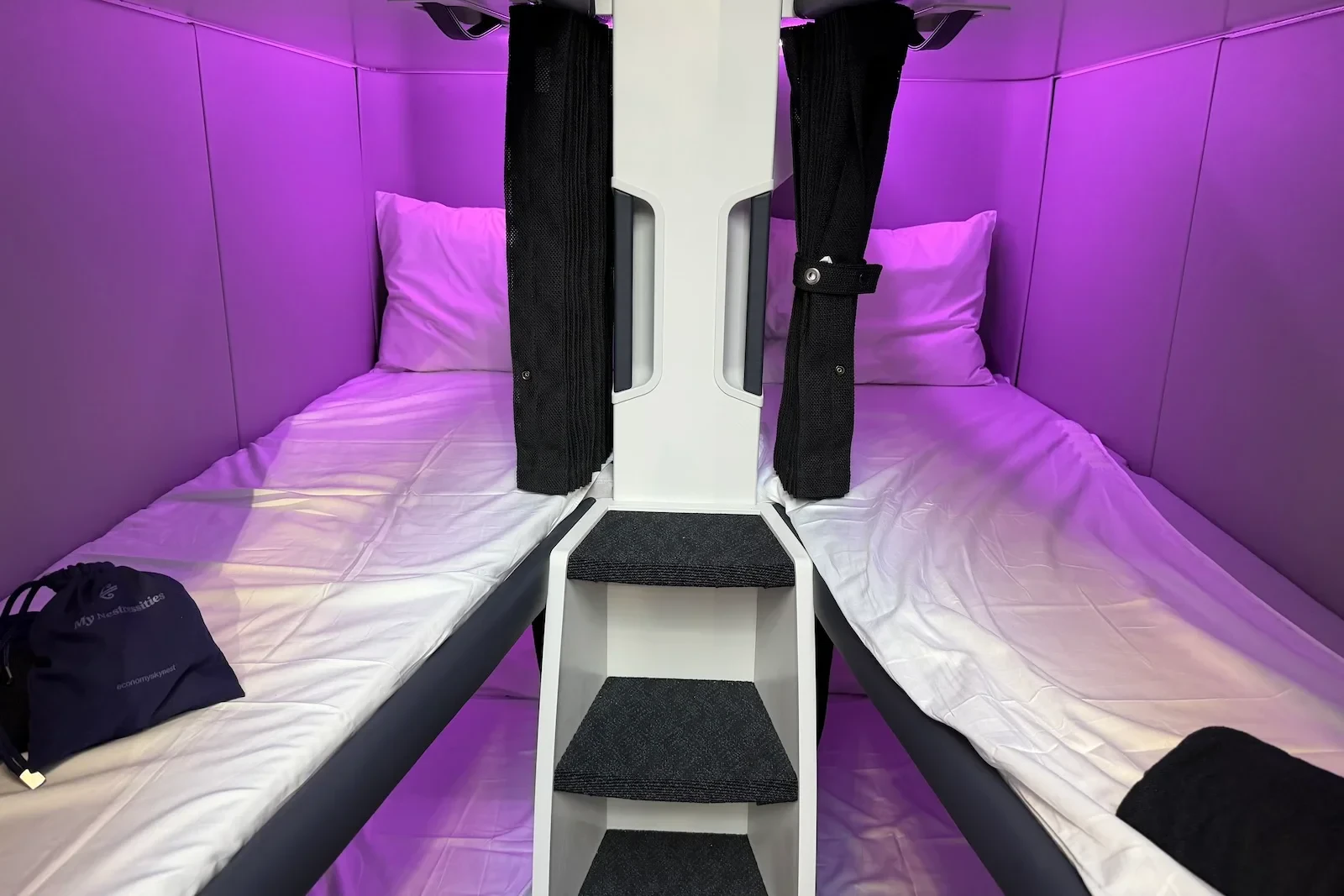
Skynest is a dedicated bunk bed cabin inside the economy cabin. Six bunks arranged in a V configuration, three levels high, each bunk offering 80 inches of length and 23 inches of width. That is a proper lie-flat bed, not a reclining seat.
Each bunk comes with full bedding including pillows, sheets, and blankets. Privacy curtains, a reading light, USB charging, ventilation outlet, and a storage pocket. Amenity kits are included. The experience is closer to a capsule hotel than an airplane seat.
The catch is that you cannot book a bunk for the entire flight. Skynest operates as a buy-up add-on for economy and premium economy passengers. You book a session, not a seat.
How Sessions Work
Each Skynest session lasts four hours. Between sessions, crew members have 30 minutes to change linens and reset the bunks. On the Auckland to New York route, which runs roughly 15 to 16 hours, Air New Zealand will initially offer two sessions per flight, with potential to expand to three.
Passengers return to their regular economy or premium economy seats for takeoff and landing. The bunk is for the cruise portion of the flight only.
Air New Zealand removes six economy seats to install the six bunks. The math is straightforward. Two sessions at NZ$495 per bunk across six bunks equals NZ$5,940 in revenue per flight. If expanded to three sessions, that rises to NZ$8,910. Compared to six economy fares, the revenue uplift is significant.
Pricing and Value
The price is NZ$495 per session, which converts to roughly US$290 to US$300 at current exchange rates. That buys you four hours of lie-flat sleep in a proper bed.
Is it worth it? On ultra-long-haul routes like Auckland to New York, business class tickets often start above US$3,000. Paying US$300 for four hours of actual sleep versus US$200 for an economy seat is not an obvious call, but for travelers who cannot afford business class and cannot sleep upright, Skynest fills a real gap.
Four hours may not cover a full night of rest on a 15-hour flight, but it breaks up the journey in a way that economy never offered before. For remote workers heading to or from New Zealand, arriving even partially rested changes the first few days on the ground.
This aligns with the slow travel trend we wrote about. When flight costs rise and jet lag hits harder, paying for actual rest becomes a strategic decision rather than a luxury.
Who This Is For
Skynest makes the most sense for three groups of travelers.
First, ultra-long-haul economy passengers who cannot sleep in seats. Auckland to New York, Auckland to Los Angeles, and similar routes leave economy passengers exhausted. A four-hour sleep session could make the difference between a ruined first day and a functional one.
Second, travelers who want business class comfort but cannot justify the price gap. If your company books you in economy but you can expense a US$300 upgrade, Skynest offers lie-flat at ten percent of business class cost.
Third, remote workers who need to be productive soon after landing. The difference between arriving groggy and arriving rested affects that first week of work in a new location. For digital nomads moving between New Zealand and North America, this product matters.
What It Does Not Solve
Skynest is not a full business class replacement. You still sit in an economy seat for takeoff, landing, and the portions of the flight outside your session. Meals are still economy meals. You do not get priority boarding or lounge access.
The four-hour session length is also a limitation. On a 15-hour flight, even three sessions would not cover the full duration. You will spend time in your regular seat. The question is whether four hours of real sleep is enough to function the next day.
Compare this to flight disruptions like the Lufthansa strike that hit travelers in April 2026. Travel planning now involves weighing not just routes and prices, but sleep quality, connection times, and recovery days.
When And Where
Skynest launches in November 2026 on Air New Zealand's Auckland to New York JFK route, operated by Boeing 787-9 aircraft. Bookings open in May 2026 for travel from November onward.
Air New Zealand has indicated that Skynest could expand to other ultra-long-haul routes if demand justifies it. The Auckland to Los Angeles route would be a logical next step, given the 12-plus hour flight time and high demand from remote workers and leisure travelers.
For now, this is a single-route product. If you are flying elsewhere, Skynest will not be an option in 2026.
How This Fits Air New Zealand's Strategy
Air New Zealand already offers Skycouch, an economy row that converts into a couch-style bed. Skycouch is 49 inches long, which is shorter than a full adult body. Skynest at 80 inches is a genuine lie-flat option.
The airline is clearly targeting the gap between economy and business class. Premium economy offers better seats but not beds. Business class offers beds but at ten times the price. Skynest sits in the middle, offering a bed for a premium that is expensive but not absurd.
For a national carrier whose geography forces ultra-long-haul routes, this product is strategic. New Zealand is far from everywhere. Making those flights survivable without business class budgets could shift how travelers choose airlines.
The Bottom Line
Air New Zealand Skynest is the first economy bunk bed product in commercial aviation. It launches November 2026 on Auckland to New York, costs roughly US$300 for a four-hour session, and offers a genuine lie-flat bed to economy passengers who cannot afford business class.
For digital nomads and remote workers traveling between New Zealand and North America, this changes the calculus of ultra-long-haul economy travel. Four hours of real sleep may not be perfect, but it beats zero hours of sleep in an upright seat.
If demand is strong, expect other airlines to study this model closely. The middle ground between economy and business class has been empty for decades. Skynest proves there is a third way.